
Two Services, One Smooth Ride
Ask ten drivers to explain wheel balancing vs wheel alignment and at least half will hesitate. Both services involve the same four wheels, the same workshop, and often the same invoice, so the confusion is understandable. They are nonetheless entirely different procedures that solve entirely different problems. Drivers in Abu Dhabi need both, and understanding why can save a considerable sum in prematurely worn tires.
Why Drivers Confuse the Two
Both services promise a smoother, straighter, more stable drive. Both are commonly bundled when new tires are fitted. Both are described in vague terms on service menus. Their symptoms also overlap just enough to mislead: a car that feels unsettled at speed may be suffering from either fault, or from both at once. The result is that many motorists book the wrong service, or skip one and assume the other has covered it.
The Short Answer
Balancing is about weight. It corrects uneven mass distribution within the wheel and tire assembly so that it spins evenly. Alignment is about geometry. It adjusts the angles at which the wheels sit relative to the car and the road so that they point in precisely the right direction. One keeps a wheel spinning true. The other keeps it facing true.
What Is Wheel Balancing?
Balancing deals with what happens inside the wheel as it rotates.
The Physics of an Imbalanced Wheel
No tire and rim combination is perfectly uniform. Rubber is molded, steel belts overlap at a splice, the valve stem adds a few grams at one point, and the rim itself carries tiny manufacturing tolerances. The sum is a heavy spot somewhere around the circumference. At walking pace, nobody notices. At 100 km/h, however, a typical wheel turns roughly 14 times every second, and on each revolution that heavy spot is flung outward by centrifugal force. The result is a rhythmic pulse that travels through the suspension into the steering wheel and the seat. A few grams of excess mass, spinning that fast, behaves like a small hammer striking the road thousands of times a minute.
Static and Dynamic Imbalance
Imbalance comes in two forms. Static imbalance is a single heavy spot on one plane, which makes the wheel hop up and down. Dynamic imbalance involves unequal mass at different points across the width of the wheel, which creates a side-to-side wobble known as shimmy. Most real wheels exhibit a blend of both. Correcting them requires counterweights on the inner and outer faces of the rim, which is why a competent balancing machine measures on two planes rather than one.
How Electronic Balancing Works
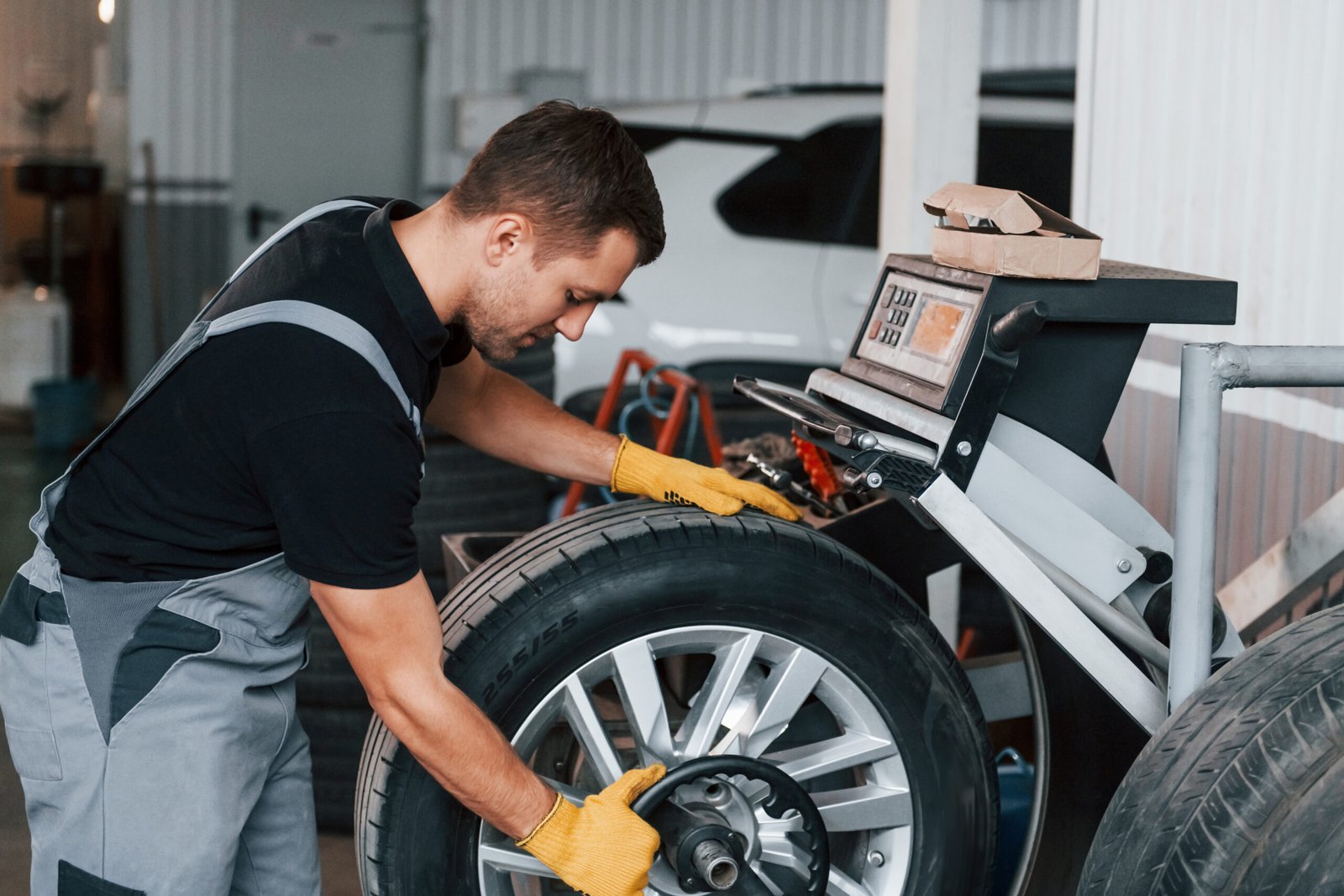
The wheel is mounted on the machine’s spindle, and the technician enters its diameter, width, and rim offset. The machine spins the assembly while its sensors detect the minute forces produced by the imbalance. The display then shows exactly how much weight is needed and where, typically down to a single gram. The technician fits adhesive or clip-on counterweights as indicated, then spins the wheel again to confirm that the readout has dropped to zero. More specialized machines go further, pressing a roller against the tire during the spin to detect stiffness variations that a conventional machine cannot see.
What Is Wheel Alignment?
Alignment deals with where the wheels point, not how they spin.
Camber, Caster, and Toe
Three angles define a wheel’s orientation.
- Camber is the inward or outward tilt of the wheel when viewed from the front. Too much negative camber wears the inner shoulder of the tire. Too much positive camber wears the outer.
- Caster is the forward or backward tilt of the steering axis, viewed from the side. It governs straight-line stability and how readily the steering wheel returns to center after a turn.
- Toe describes whether the fronts of the wheels point slightly inward or outward when viewed from above. It is the most sensitive of the three. Even a few millimeters of error drags the tread sideways with every meter traveled.
Thrust Angle and Four-Wheel Alignment
The front wheels are only half the story. The thrust angle describes the direction in which the rear axle points relative to the car’s centreline. If it is off, the car travels slightly crabwise, a condition mechanics call dog-tracking, and the driver compensates with constant small steering corrections without realizing it. Four-wheel alignment measures all four wheels and, where the vehicle allows, adjusts them so the entire car tracks as one.
How Computerized Alignment Works
Sensors or reflective targets are clamped to each wheel, and the system reads their positions through cameras or wireless sensors. The car sits on a level rack, and the technician performs a compensation routine to cancel out any distortion in the rims. Software then compares the live measurements against the manufacturer’s specification and displays deviations on screen, often as color-coded bars. The technician adjusts tie rods, eccentric cam bolts, or shims until every reading falls within tolerance, and prints before and after figures so the improvement is documented. Readings are only trustworthy when tires are at the correct pressure and the suspension and steering parts are sound, so a good technician inspects those first.
Balancing vs Alignment: The Key Differences
The two services are easy to compare once you separate the cause from the symptom.
What Each Service Corrects
- Balancing corrects uneven weight distribution in the wheel and tire assembly. Alignment corrects the angles of the wheels relative to the vehicle and the road.
- An imbalance typically shows up as vibration. A misalignment typically shows up as pulling or an off-center steering wheel.
- Imbalance tends to leave cupped or patchy wear. Misalignment tends to wear one edge of the tread or leave a saw-tooth feathering across the blocks.
- Balancing is fixed with counterweights. Alignment is fixed by adjusting suspension and steering components.
Equipment and Procedure
Balancing takes place with the wheel removed from the car and mounted on a spinning machine, and it usually takes a matter of minutes per wheel. Alignment takes place with the wheels on the car and the car on a rack, and it usually takes around 30 to 60 minutes. Different machines, different skills, different results. That is why one cannot substitute for the other.
Symptoms: How Your Car Tells You Which One It Needs
Your hands, ears, and eyes provide most of the diagnosis.
Signs of Unbalanced Wheels
- A vibration in the steering wheel that appears in a band of speeds, commonly between about 80 and 120 km/h, and may fade above or below it.
- A buzz felt through the seat or floor, which usually points to the rear wheels.
- A rhythmic drone that rises and falls with speed.
- Scalloped or patchy tread wear, known as cupping.
- Vibration that persists after balancing, which may indicate a damaged tire, a bent rim, or a worn suspension component.
Signs of Misalignment
- The car drifts to one side on a straight, level road.
- The steering wheel sits off-center when you are driving straight.
- Tread wear concentrated on one shoulder, or feathered across the tread blocks.
- The steering wheel is slow to return to center after a turn.
- Tires squeal on ordinary corners.
Why You Need Both
Treating the two services as alternatives is a false economy.
How the Two Problems Compound Each Other
A car can be perfectly aligned and still shake. A wheel can be perfectly balanced and still wear unevenly. Neither service compensates for the other. Misaligned wheels scrub rubber from the shoulders even if they spin smoothly, while unbalanced wheels hammer the tread into cupped patches even if they point straight. When both faults coexist, wear accelerates and the symptoms disguise each other: a vibration can mask a pull, and a pull can distract from a vibration. Fixing only one often leaves the driver puzzled about why the problem has not gone away.
Protecting Tires, Suspension, and Fuel Economy
Tires are among the most expensive consumables on a car, and they are the first casualty when either fault goes uncorrected. The damage does not stop there. Wheel bearings, ball joints, shock absorbers, and steering components absorb the repeated shock loads from imbalance and the constant strain of misalignment, so they wear sooner as well. Wheels that fight each other also raise rolling resistance, which can cost a small but real amount of fuel over thousands of kilometers. Doing both properly is cheaper than replacing tires early.
How UAE Driving Conditions Affect Both
Local conditions change how quickly these problems develop.
Speed Bumps, Kerbs, and Desert Tracks
UAE roads are smooth, but they are not hazard-free. Speed bumps taken too fast, kerbs clipped while parking, and weekend trips onto sand tracks all deliver sharp impacts that can nudge suspension geometry out of specification. Dried mud or packed sand inside a rim, or a dislodged counterweight, can also upset balance after a desert drive. These problems build slowly, which is why many drivers do not notice until the tires are already damaged.
Heat and High-Speed Highways
Long, fast highway stretches are exactly where a vibration band becomes most noticeable, and the same distances put heavy mileage on tires in a short time. Sustained heat is hard on rubber, bearings, and the adhesive used for some counterweights, so periodic checks make sense. Tire pressure also rises with temperature, and uneven pressure changes how a car tracks, so alignment should always be carried out with the tires correctly inflated.
How Often Should You Have Each Done?
There is no single schedule, but these guidelines cover most drivers.
Balancing Intervals
Balance the wheels every time a tire is fitted or repaired, and whenever a vibration appears. Many technicians also recommend a check at each tire rotation, which typically falls around every 10,000 km.
Alignment Intervals
Have the alignment checked at least once a year, or roughly every 10,000 to 20,000 km, and after any suspension or steering repair. A check costs little and gives you a printed record of where the car stands.
Moments That Call for Both
- Fitting a new set of tires.
- Hitting a kerb or speed bump hard.
- Replacing suspension or steering parts.
- Noticing uneven tire wear.
- Before a long road trip, especially in summer.
- Any time the car feels different from how it did a few months ago.
What to Expect at the Workshop
A balancing visit follows a simple sequence.
- The wheel is removed and cleaned, and old counterweights are taken off.
- Pressure is checked and the wheel is mounted on the machine.
- Dimensions are entered and the wheel is spun.
- Counterweights are fitted where the display indicates.
- The wheel is spun again to confirm a zero reading, then refitted with the lug nuts tightened to the specified torque.
An alignment visit follows a different one.
- The technician inspects the tires, suspension, and steering components for wear or damage.
- Sensors are attached to all four wheels and the initial readings are recorded.
- Adjustments are made until each angle falls within the manufacturer’s tolerance.
- Before and after figures are shown or printed, and the technician confirms the steering wheel sits centered.
Ask to see the readout from both. Any reputable workshop is happy to show you.
Common Myths
A few persistent misconceptions lead drivers to book the wrong service.
Myths About Balancing
- Balancing stops a car pulling to one side. It does not. Pulling is an alignment problem.
- New tires arrive pre-balanced. They do not. Every tire and rim combination must be balanced after mounting.
- A little vibration is normal. It is not. A steady shake means something is out of balance, worn, or damaged.
Myths About Alignment
- Alignment is only needed after an accident. In reality, geometry drifts gradually through everyday driving.
- Alignment cures a shaking steering wheel. It rarely does. That symptom usually points to balance.
- New tires do not need alignment. A misaligned car will wear through a brand-new set faster than a worn one.
Conclusion
Balancing and alignment are partners, not rivals. One makes the wheels spin evenly and the other makes them point correctly, and a car needs both to ride smoothly, track straight, and keep its tires for their full life.
Quick Reference Checklist
- Vibration at speed: balancing.
- Pulling or an off-center steering wheel: alignment.
- Uneven tire wear: alignment first, then check the balance.
- New tires: balance them, and check the alignment.
- After hitting a kerb or speed bump hard: alignment check.
- Unsure which one you need: have both checked.
Where to Book in Musaffah
RAS Auto Services in Musaffah, Abu Dhabi offers electronic wheel balancing and computerized wheel alignment under one roof, so both can be handled in a single visit. Technicians can work out which service your car needs and carry out both when required. Visit the workshop at 17th St, Musaffah M-32/2, or call +971-54-779-3848 to book.